



Memorie di un pazzo
 "possono divertire il pubblico gli scritti di un uomo annoiato?" (pag. 33)
in questo caso, decisamente no.
Anger: Wisdom for Cooling the Flames
 I started reading this book without knowing what to expect, hoping to get some useful advice and inspirational ideas. Instead, the book quickly started to annoy me, having to much of the following:
1) preachy and patronizing sentences, such as: we must recognize... we need to... it is important to... that is the real truth ... that is sheer ignorance...
2) many clichés,
People actually need only half of the food that they daily eat.
To eat properly, you should chew food at least 50 times before ingesting it.
Seriously? why not 48 or 52. That's the kind of junk information usually found in random websites or in cheesy TV shows. I expected something better from one of the wisest men in the world.
3) unclear and unexplained concepts, such as
Non-self is not an abstract philosophy. Non-self is a reality that you can touch by living mindfully.
Also, obscure concepts are explained with even more obscure examples, like when we are informed that body and mind are not separate entities, just like a photon, that it is both particle and wave (as everyone knows from everyday experience).
4) trite and commonplace ideas shown as something extraordinary.
5) silly and childish examples
When you cook potatoes, you need to keep the fire going for at least fifteen or twenty minutes. You cannot eat raw potatoes. While cooking your potatoes, you have to cover the pot in order to prevent heat from escaping. When you remove the lid of the pot, the potatoes will smell wonderful.
6) sentences and ideas repeated over and over
7) weird theories, without any demonstration; they must be true because the author says so.
Nowadays, chickens are raised in large-scale modern farms where they cannot walk, run, or seek food in the soil. [...] There is a lot of anger, a lot of frustration, and much suffering in the chickens.
[...] So when you eat the flesh or egg of such a chicken, you are eating anger and frustration. So be aware. Be careful what you eat. If you eat anger, you will become and express anger. If you eat despair, you will express despair. If you eat frustration, you will express frustration. We have to eat happy eggs from happy chickens.
I feel a bit angry today. I guess my breakfast contained eggs from angry chicken.
But the main problem with this book is, in my opinion, that to be able to practice any of the improvement ideas mentioned in it, the reader first needs to learn and practice some techniques called Conscious Breathing, Walking Meditation, Mindfulness, Deep Listening, and so on. Therefore, reading the book is basically useless for anyone unfamiliar with such techniques.
The author explains that when angry we should avoid saying or doing anything, to not make things worse. That seems reasonable, even a bit obvious, yet not very useful, because reading about how to control anger is not enough to control it. Apparently, to control anger, we first need to practice Conscious Breathing and Walking Meditation and so on; too bad we can't learn such things from reading this book, or any book. Then, again, what's the point of reading this book.
The Wisdom of Psychopaths
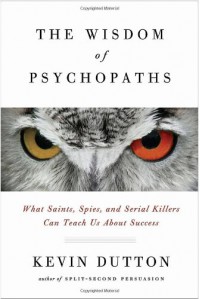 In the preface, Dutton remembers with pride and admiration his father, the amazing salesman who once sold a whole load of datebooks that only had eleven months instead of twelve: "Unique opportunity to get your hands on an eleven-month diary, folks ... sign up for a special two-for-one offer and get an extra month thrown in next year for free"..
But this is nothing compared to what Kevin Dutton is doing: selling an useless book, by suggesting that it can make readers more successful. "What saints, spies and serial killers can TEACH US about SUCCESS". "You could probably benefit from being a little more psychopathic yourself"... Yeah, right.
As if someone could deliberately chose to become a bit more psychopathic in order to become more successful.
At this point, the writer has already lost all credibility.
I started asking myself: is this guy writing out of passion, or maybe because he genuinely believes he is writing something useful, or just because he wants to make money and become famous?
After reading the preface, the purpose of the writer seemed already obvious to me.
"Psychopaths are fearless, confident, charismatic, ruthless, and focused." then "there are times when it’s actually a good thing when, by being a psychopath, you in fact have an advantage over other people".
Indeed, "a number of psychopathic traits were more prevalent among business leaders than among diagnosed criminal psychopaths".
This is the main idea, and it is repeated over and over in the book, in case readers did not get it by reading the book cover.
"The wisdom of psychopaths" is actually mildly entertaining, but also very repetitive, verbose, pretentious, and biased as it is promoting the writers point of view and his work ("I know, because I’ve tested them"). Sometimes it looks like the writer is just showing off ("I have cradled John Wayne Gacy’s brain in my hands") - the guy seems quite full of himself.
What this book really teaches us is that anyone can sell anything by using some shameless marketing techniques. How?
1) find a title that sounds brilliant, witty, eye-catching, odd, contrary to popular belief and distant from what we know from common sense (something like: "the wisdom of psychopats" or maybe "the joy of suicide" or why not, "the pleasure of depression"). People will think "oh really? I never thought of it, how can it be? I'm curious to know more". The subject will be perfect for small talk during coffee break in offices: "did you know that psychopats have a unique set of skills?" "let's find our if our boss is a psychopath". Someone might even buy the book (I'm so glad I didn't).
2) suggest the idea that readers will be able to become more successful after reading the book.
It's not true, but it does not matter, since most readers will find out after buying the book, not before.
3) include some interviews to top managers, top lawyers, top movie stars, top secret agents, top serial killers, basically anyone who is TOP, VIP, glamourous and trendy. If you don't have much time, just make up the interviews, pretending they wanted to stay anonymous: it's a lot faster and nobody will ever know.
4) search the scientific literature, you can always find a few studies that seem to support your bizarre theory. Like the study about collecting sweat from the armpits of first-time skydivers and waving it under the noses of a second bunch of volunteers, to see if they can smell fear in the sweat. A bit bizarre indeed. But it must be true and reliable because the writer says so.
5) work with top marketing experts to advertise the book on the media
Then you should become a top writer and maybe someday someone will interview you as an example to prove his bizarre theories about successful writers.
The Road (Movie Tie-in Edition 2008) (Vintage International)
 Papa, is this book a joke?
I don't know.
What do you mean you don't know?
I mean I don't know, he said.
You don't know if this book is a joke?
No.
But what do you think.
I think it's unlikely.
Okay.
Just drop it, we need to move on.
Why?
You are getting bored and frustrated.
But Papa, I don't have anything else to read.
We'll find something in a while.
How do you know?
I just know.
How long a while?
I don't know. Maybe quite a while.
Okay.
Stop saying okay.
Okay.
You always say that.
I'm sorry.
I know. But you do.
I'm really bored, Papa.
I know.